We can help you find the risk before it finds you.
Riskalytics AI helps your team bring field observations and site context together, develop reports for professional review, and plan focused security improvements.
FIND YOUR ENVIRONMENT
Explore an Example Relevant to Your Organization.
FICTIONAL ASSESSMENT CONTEXT
One site. Many conditions to understand.
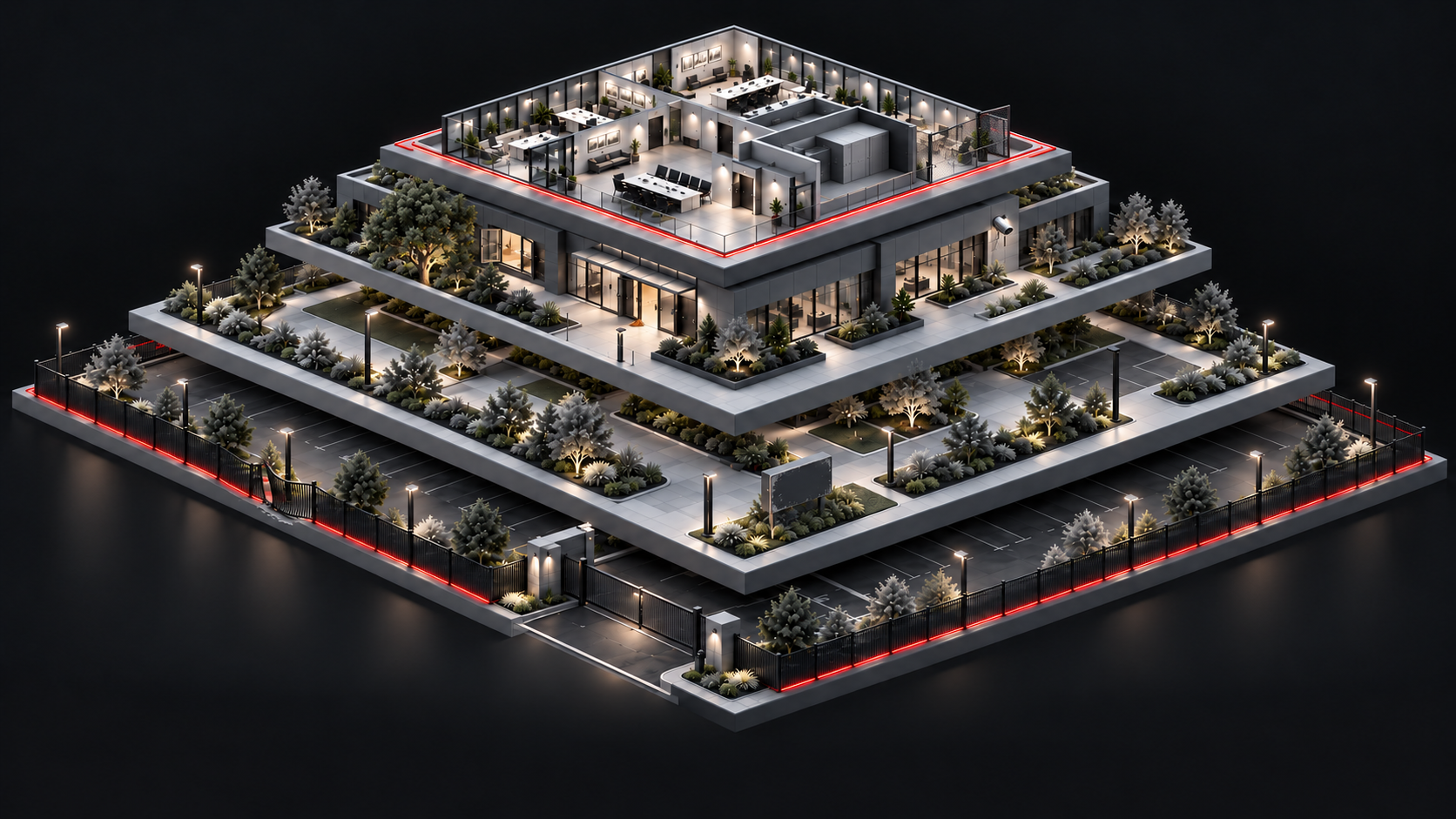
Explore common physical conditions, operating practices, and system-review questions in an illustrative facility.
Consider how organized evidence can support professional review, clear ownership, and practical improvement planning.
Illustrative situations, not customer case studies or a complete assessment. Examples describe intended support, not measured client results.
What Might a Site Assessment Reveal?
Explore twelve assessment topics. Hover over an icon, use your keyboard, or tap a topic to see a staged example and how Riskalytics AI can assist.
01 / DAMAGED FENCE
AI-generated staged example. Not client evidence.
A boundary condition worth documenting.
Help your team organize photographs, observations, and relevant maintenance information about a damaged fence. Support professional review of the condition, its site context, and practical repair or follow-up priorities.
02 / UNLIT LIGHTING
AI-generated staged example. Not client evidence.
Clarify what an observation can establish.
Record an apparently unlit fixture and relevant lighting concerns for follow-up. Riskalytics AI can help organize the evidence and validation questions; one daytime observation cannot establish whether a lamp has failed or whether illumination is adequate.
03 / PROPPED-OPEN DOOR
AI-generated staged example. Not client evidence.
Connect a door condition to operating practices.
Capture the observed door condition, available context, and relevant staff input. Help professionals consider whether this is a temporary activity, a recurring practice, or an item needing follow-up, with life safety and authorized operating requirements taking precedence.
04 / ROOF-ACCESS CONCERN
AI-generated staged example. Not client evidence.
Identify a question for appropriate review.
Document an observed roof-access condition and the information needed to understand its authorization and controls. Support a qualified review and an ownership discussion without assuming that the observation alone proves unauthorized access is possible.
05 / VEGETATION NEAR WINDOWS
AI-generated staged example. Not client evidence.
Bring landscaping and building context together.
Organize observations about vegetation near windows, visibility, and ongoing upkeep. Help teams bring CPTED considerations into a professional review and discuss proportionate maintenance options without treating landscaping alone as a confirmed vulnerability.
06 / POOR WAYFINDING
AI-generated staged example. Not client evidence.
Make arrival and navigation concerns easier to discuss.
Capture unclear, damaged, or inconsistent signs alongside site observations and user feedback. Help teams develop clearer improvement conversations around arrivals, navigation, and intended use of the space.
07 / CAMERA NEEDING INSPECTION
AI-generated staged example. Not client evidence.
Separate visible condition from verified performance.
Organize evidence of apparent camera damage or misalignment and the intended coverage needs. Support inspection and repair discussions; recording, field of view, image quality, and system performance require validated system information and appropriate testing.
08 / VMS LIFECYCLE
AI-generated staged example. Not client evidence.
Is the video platform still fit for its job?
Bring documented software versions, vendor-support information, maintenance history, and operational needs into review. Riskalytics AI can help organize lifecycle questions and improvement priorities. Age or appearance alone does not establish that a Video Management System is obsolete; support status, compatibility, and performance need verification.
09 / GUARD-POST READINESS
AI-generated staged example. Not client evidence.
Assess the service against its intended role.
Organize documented observations, post requirements, relevant service records, and staff input to support a review of guard-service effectiveness. Clarify training, supervision, and operating needs before deciding on improvements. An empty post or a single observation alone does not establish poor performance.
10 / DAMAGED PERIMETER LIGHTING
AI-generated staged example. Not client evidence.
Connect a visible defect to verified follow-up.
Document damaged perimeter fixtures and relevant maintenance information. Help professionals organize inspection questions, ownership, and repair priorities. Nighttime illumination, electrical condition, and system performance require appropriate testing; a photograph can show damage without establishing the full extent of the problem.
11 / OBSTRUCTED SIGHTLINES
AI-generated staged example. Not client evidence.
Review visibility in the context of daily use.
Organize observations about planting, structures, and other conditions that limit visibility around arrival areas or shared spaces. Bring CPTED considerations and local operating context into professional review, then support practical maintenance or design discussions. An obstructed view alone does not establish the level of risk.
12 / VISITOR CHECK-IN
AI-generated staged example. Not client evidence.
Connect the arrival experience to intended procedures.
Bring observed check-in practices, visitor instructions, and relevant staff input together for review. Help teams clarify responsibilities and discuss improvements that fit the site’s operations. A reception photograph cannot establish whether visitors are authorized or whether the procedure is followed consistently.
Fictional examples for discussion, not actual client findings or a complete assessment. Markers indicate discussion topics, not verified equipment locations or findings. Every condition requires context and appropriate professional validation. Your organization defines the assessment around its own environment, operations, and priorities.
FROM CONTEXT TO CAPABILITY
A Site Is More Than a Building. An Assessment Should Be More Than a Report.
UNDERSTAND
Bring the whole site into view.
Consider exterior conditions, arrival areas, entries, public spaces, and operations together. Bring local knowledge and relevant evidence into the review so priorities reflect how the site actually works.
PLAN
Focus effort where it matters.
Turn professionally reviewed findings into practical improvement conversations. Weigh operational constraints, ownership, and available resources to support better-informed investment and phased planning.
REVISIT
Keep the program moving.
Revisit conditions as sites change, document progress, and follow through on open items. Build a repeatable assessment capability rather than starting from scattered notes each time.
Assistive Intelligence supports the work. Qualified professionals remain responsible for validation, recommendations, decisions, and risk acceptance.
EXPLORE THE FIT
Bring Your Sites and Your Challenges to the Conversation.
See how a more structured assessment process could support your team’s security planning and follow-through.